Google AI Mode in Ireland: how it changes local search.
Irish search habits split in 2025. AI Mode usage in Ireland grew from ~30 monthly searches in April 2025 to ~2,900 in March 2026, over a 25× increase. Half the queries that used to land on your blue-link rankings now land in a generated answer that names 3–5 businesses. If you're not one of them, you don't exist for that query. This guide is what your business actually has to do to be cited. (For the broader strategy, see AI SEO Ireland.)

Why this matters in Ireland right now
Three numbers tell the story. First, Google AI Mode searches in Ireland grew from ~30 monthly to ~2,900 monthly between April 2025 and March 2026, a 25× increase in 12 months. Second, the queries migrating fastest are the commercial-intent ones, "best [service] in [city]", "X vs Y", "is [business] reliable", exactly the queries Irish service businesses depend on for lead flow. Third, AI Mode answers cite a small set of businesses, typically 3–5 per query. The blue-link long tail is gone in this surface; you're either cited or invisible.
The Irish market is unusually open right now. Most Dublin agencies haven't started optimising for AI search at all, their pitches are still about "ranking #1 on Google" while half their clients' high-intent traffic is moving to AI Mode and ChatGPT. That gap is closing fast in the US and UK markets but is wide open in Ireland for the next 6–12 months.
This guide is structured as nine sections, what AI Mode is, why it matters, how it picks citations, and five tactical fixes you can ship this quarter. Each section ends with a takeaway and concrete next steps. For the broader Generative Engine Optimisation framework, see our GEO for local businesses guide; for the agency engagement, see AI SEO Ireland.
What is Google AI Mode and how it differs from AI Overviews
CriticalGoogle AI Mode is a separate search experience launched globally in 2025, accessed via the dedicated "AI Mode" tab next to All, Images, and Videos in Google Search. It uses a custom version of Gemini to handle multi-turn conversational queries, follow-up questions, comparisons, planning, reasoning, and returns a generated answer that cites sources inline. AI Overviews, by contrast, are the summary boxes that appear at the top of standard Google results pages for specific queries. AI Mode is a destination; AI Overviews are an interruption to blue-link search.
Key points
- AI Overviews, appear above blue links, summarise an answer, link to 3–5 sources. The user is still on the standard SERP.
- AI Mode, the user enters a separate conversational interface, asks multi-turn questions, gets a longer reasoned answer with denser citations.
- What both share, they pick a small set of sources to cite. Being one of those sources is what GEO optimises for.
- What changed in Ireland, AI Mode usage in Ireland grew from ~30 monthly searches in April 2025 to ~2,900 in March 2026, over a 25× increase in 12 months.
Why Irish businesses should care about AI Mode now
CriticalIrish search habits are following the global pattern: high-intent informational and comparison queries are migrating from "google it" to "ask ChatGPT" or "use AI Mode". This matters for two reasons. First, the SERPs you've been ranking on for years are losing share, your blue-link traffic flattens or declines even when your rankings hold. Second, the queries that move to AI surfaces are the high-intent ones, "best X in Dublin", "X near me", "X vs Y", because those are the questions AI is best at answering. If you're not cited in those answers, you don't exist for that query in 2026.
Key points
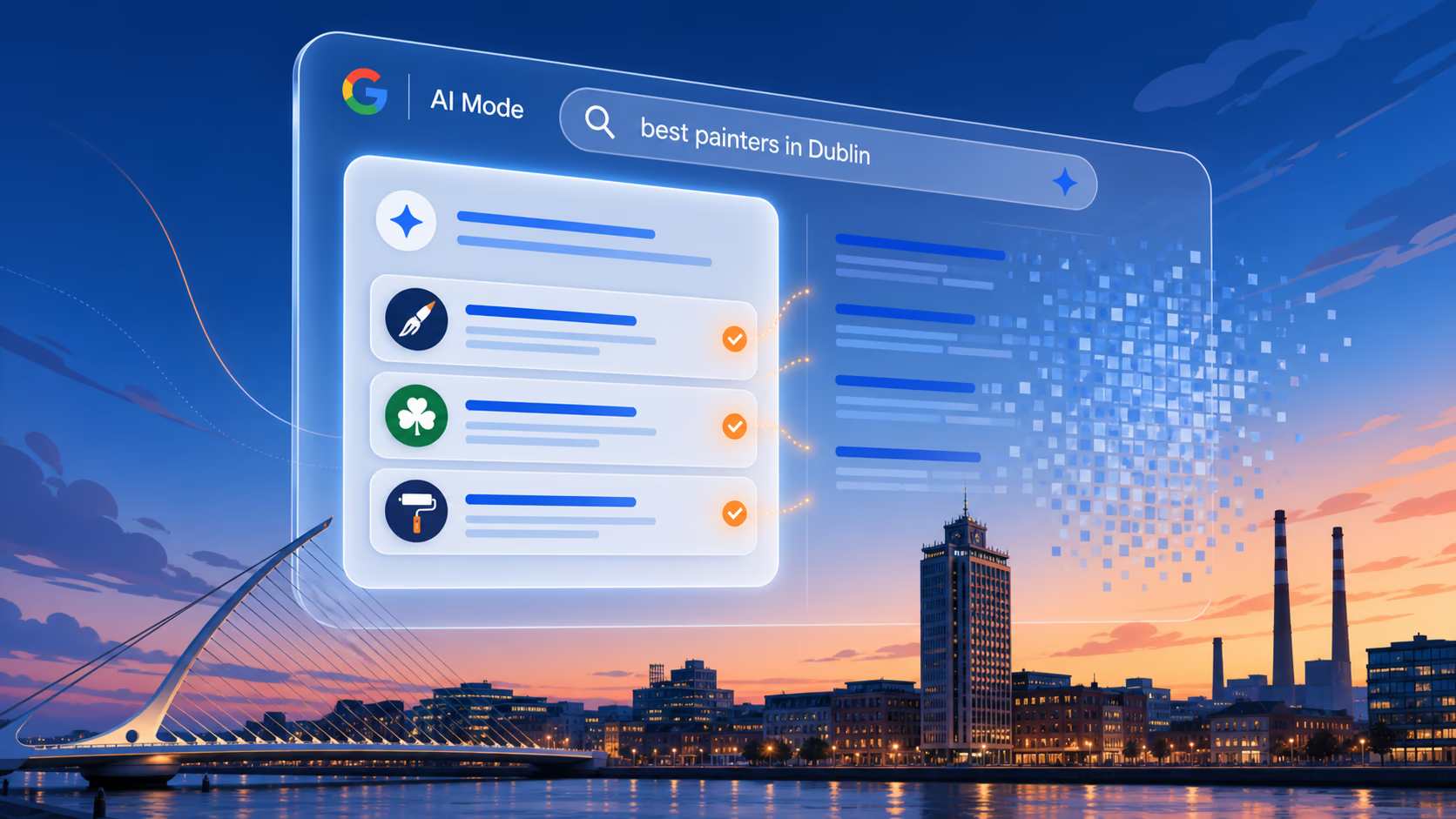
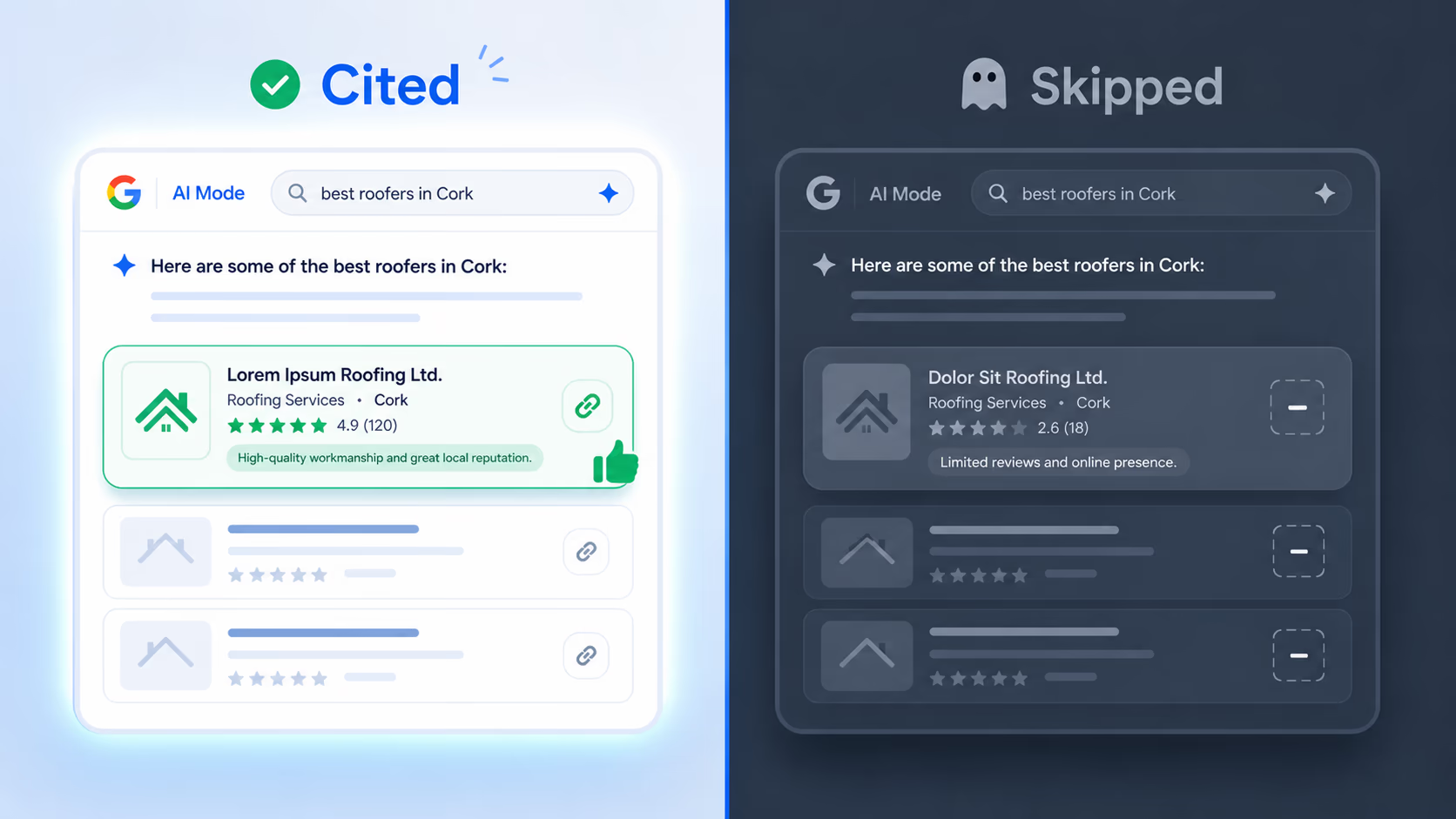
- Buyers asking AI Mode "best painters in Dublin" will see 3–5 named businesses, not a 10-blue-link SERP. Get cited or get skipped.
- AI Mode answers Irish-specific local queries by combining Google Business Profile data + web citations + Reddit/Boards.ie sentiment. All three need work.
- The Irish market is unusually open, most Dublin and regional agencies are still pitching "rank #1 on Google" without addressing AI surfaces at all.
- For context on what GEO actually involves, see our GEO for local businesses guide.
How AI Mode picks which businesses to cite
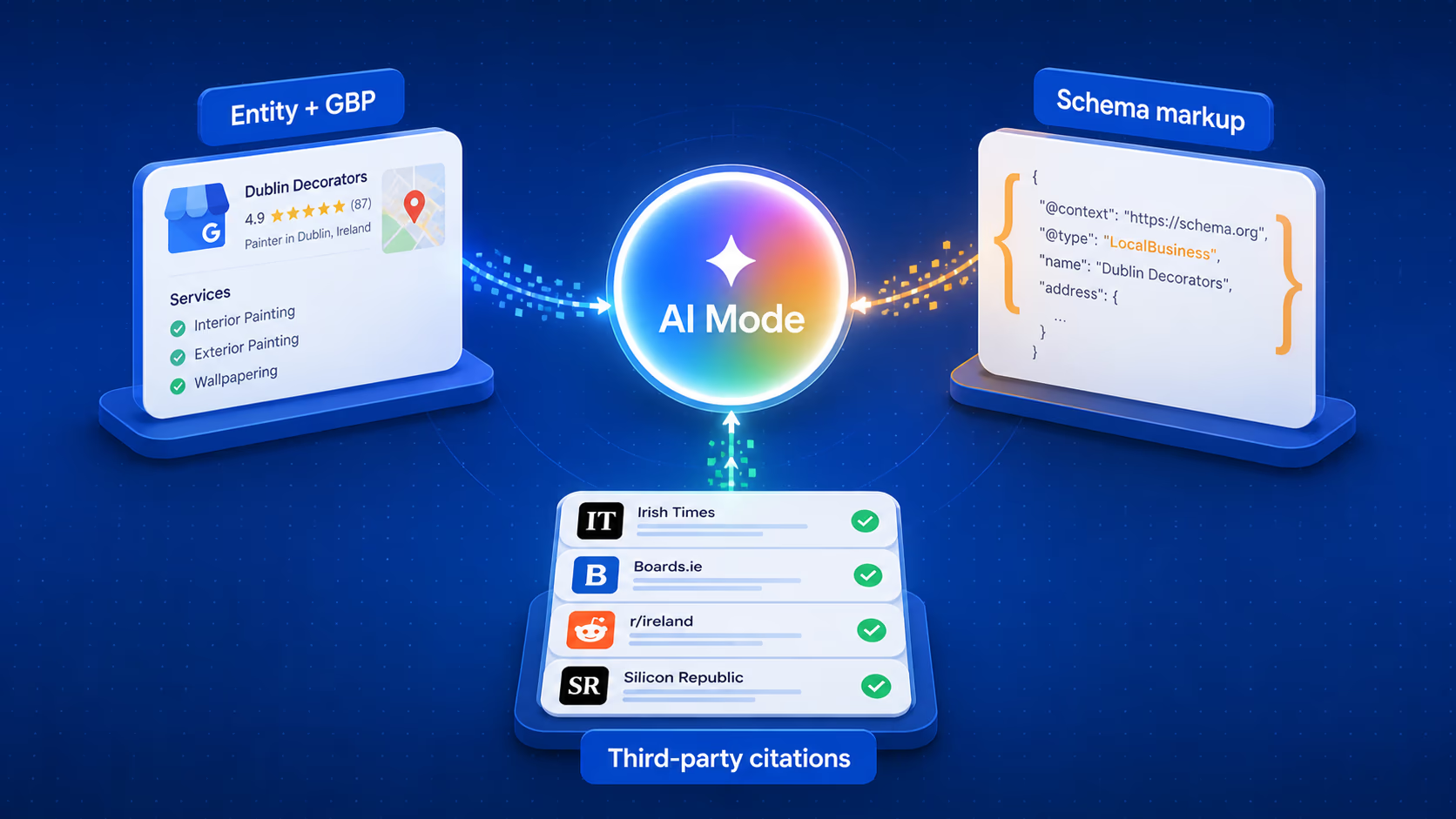
CriticalAI Mode is a Gemini-based system, but the source selection layer relies on a combination of Google's own knowledge graph, the public web (including Bing for some traffic-tier sites), and structured data. The signals it weights are different from classic blue-link SEO. Three things matter most: (1) is your business clearly identifiable as an entity in Google's knowledge graph; (2) is there enough authoritative third-party content describing what you do; (3) does your own site mark up that information cleanly with schema. Pages that rank #1 on Google but lack schema and entity signals often don't get cited in AI Mode answers.
Key points
- Entity match, does Google's knowledge graph have a clean record of your business name + category + location?
- Schema density, Organisation, LocalBusiness, Service, FAQ, and Review schema all feed AI Mode's confidence in citing you.
- Third-party citations, Boards.ie threads, Irish Times articles, RTÉ mentions, Reddit r/ireland posts. AI Mode triangulates across sources.
- Citable passages, short, factual, opinion-grounded paragraphs that survive summarisation. Generic blog filler is invisible.
Optimise your Google Business Profile for AI Mode local queries
CriticalFor local queries, "best [service] in [Irish city]", AI Mode pulls heavily from Google Business Profile data. The signals are the same as map-pack ranking, but AI Mode also reads your "Services" field, "From the business" description, and structured Q&A as candidate text for citation. A Profile that ranks well in the 3-pack but has thin Services data and no Q&A often gets summarised into one generic line, while a competitor with detailed services and an active Q&A gets a paragraph. See our full Google Business Profile checklist for the complete optimisation playbook.
Key points
- Fill every "Services" field with detailed, keyword-relevant descriptions, AI Mode quotes from these directly.
- Add 5–10 Questions to your GBP Q&A and answer them yourself with helpful, specific answers, these become AI Mode quote candidates.
- Post weekly updates (offers, news, milestones), recency is a signal AI Mode uses for "actively operating" assessment.
- Match NAP exactly across all top Irish citations so the entity match is unambiguous.
Add schema markup that AI engines actually use
HighIn the blue-link era, schema was a "nice-to-have" that earned you rich snippets. In the AI Mode era, schema is the difference between "cited correctly" and "cited inaccurately or skipped". When AI Mode generates an answer mentioning your business, it cross-references your schema for facts, services, prices, hours, location, founder name, to ground its statement. If schema is missing, the model either falls back to less reliable sources (which may name a competitor) or omits you to avoid hallucination. Five schema types matter most for Irish businesses: Organisation, LocalBusiness, Service, FAQPage, and Review.
Key points
- Organisation + LocalBusiness, your foundational entity record. Include @id with a self-canonical URL fragment for stable identity.
- Service schema, one entry per offering, with name, description, and areaServed (use Country: Ireland, plus specific cities you serve).
- FAQPage schema, every FAQ section on your site should be marked up. AI Mode pulls FAQ Q&A pairs as direct citation candidates.
- Review + AggregateRating schema, feeds AI Mode's "is this business well-regarded" assessment. Pull reviews from verified review sources, never fake them.
Build third-party citations on Irish authority sites
HighAI Mode rarely cites a business based on its own website alone. The model looks for corroboration: does the business appear in independent listicles, news mentions, expert roundups, or forum recommendations? For Irish businesses, the highest-leverage citation surfaces are Irish Times Directory, Silicon Republic, RTÉ business coverage, Boards.ie threads, and Reddit r/ireland or r/AskIreland recommendations. A single Silicon Republic feature is worth more for AI Mode citation than 10 generic directory listings. See our link building Ireland tactics guide for the eight tactics that earn these.
Key points
- Tier 1, Irish Times, Silicon Republic, RTÉ, Independent.ie. One feature here is worth the entire campaign budget.
- Tier 2, Industry publications, Irish trade bodies, professional association directories.
- Tier 3, Boards.ie, Reddit r/ireland, Quora, niche Irish forums. Authentic participation only, AI Mode penalises spammy patterns.
- Tier 4, High-quality Irish directories (see our top 12 Irish citation list).
Engineer your content for AI Mode citation
HighGeneric content, "Our team is dedicated to delivering quality results for our clients", is invisible to AI Mode. The model looks for paragraphs with a specific claim, an opinion, a comparison, or original data. Two structural patterns earn the most citations: the "answer-first paragraph" (lead with the specific answer in 2–3 sentences, then expand) and the "comparison passage" (X works for case A, Y works for case B). Listicle inclusions also rank highly because the listicle structure already isolates each item as a citable unit.
Key points
- Lead every section with a 2–3 sentence answer-first paragraph that could stand alone as a citation.
- Use structured comparison patterns: "X is better when Y; Z is better when W." AI Mode quotes these directly.
- Include original data, opinions, or first-hand observations. Bland synthesis of competitor content earns no citations.
- Add an FAQ section to every important page, AI Mode pulls FAQ Q&A pairs more reliably than long-form prose.
Monitor your AI Mode citations monthly
HighUnlike Google blue-link rankings, AI Mode answers vary by query phrasing, conversational context, and model version. A query that cites you today may cite a competitor next week if their entity authority improves or a new third-party article ranks. The only reliable optimisation loop is: (1) define a target query set per category; (2) run those queries on AI Mode, ChatGPT, Perplexity, and Claude monthly; (3) log which businesses are cited and from which sources; (4) ship work to fix the gaps. Manual checks work for 5–10 queries; for larger sets, AI visibility tools like Profound, Otterly, or AthenaHQ track citations at scale.
Key points
- Define your top 20 category queries, what would a buyer actually type into AI Mode?
- Run them monthly across AI Mode, ChatGPT, Perplexity, and Claude. Document who's cited and what content the engines pulled from.
- Track citation source, is it your site, a third-party listicle, a Reddit thread, or a competitor's comparison page?
- Ship one improvement per month based on the gaps. Citations move within 4–8 weeks of the fix.
Mistakes that get Irish businesses skipped by AI Mode
WatchAI Mode has different failure modes from classic search. Keyword stuffing, while still a Google penalty, mostly gets your passage skipped by AI Mode rather than penalised, the model looks for natural, factual prose. The bigger risks are entity ambiguity (multiple businesses with similar names), schema/page mismatch (your schema says you're a dentist, your homepage talks about marketing), and over-claiming credentials that AI Mode can't verify. The model is conservative, when in doubt, it skips you and cites a competitor whose entity profile is cleaner.
Key points
- Entity ambiguity, two Irish businesses with similar names (and unclear differentiation) often get neither cited.
- Schema/content mismatch, schema must accurately reflect what the page says. AI Mode treats mismatch as a low-trust signal.
- Generic content, "Our team is dedicated…" passages get filtered out before citation selection.
- Over-claiming, "Ireland's #1 X agency" without verifiable third-party support reduces citation likelihood.
Frequently asked questions
Is Google AI Mode actually available in Ireland?
Yes. Google AI Mode rolled out globally during 2025 and is fully available in Ireland on desktop and mobile, on iOS and Android. Access it via the "AI Mode" tab next to All, Images, Videos in standard Google Search.
How is AI Mode different from Google AI Overviews?
AI Overviews are summary boxes above the blue links on standard Google search results. AI Mode is a separate conversational interface where you have multi-turn conversations and get longer reasoned answers with denser citations. They share the underlying Gemini model but serve different query types, Overviews for quick informational lookups, AI Mode for comparison, planning, and reasoning queries.
Does ranking #1 on Google guarantee AI Mode citation?
No. AI Mode uses a different signal mix. Pages ranking #1 but lacking schema, entity authority, or citable content frequently fail to be cited. The overlap is roughly 50–60%, half of #1-ranked pages in Ireland are also AI Mode citations; the other half are skipped in favour of competitors with cleaner entity profiles.
Should I optimise for ChatGPT, Perplexity, and Claude as well?
Yes. The work overlaps heavily, entity authority, schema, and citable content help all four engines. The differences are at the margin: ChatGPT weights Bing index more heavily, Perplexity weights recency, Claude weights authoritative single-source citations. Optimise once for the core, then refine per-engine based on monitoring.
How fast does AI Mode optimisation move citations?
Entity profile + schema fixes move citations in 4–8 weeks. Third-party citation building takes 3–6 months to compound. Most Irish businesses we work with see meaningful AI Mode visibility within 4–6 months, faster than classic SEO because the channel is less mature and competition is thinner.
Will AI Mode kill organic traffic to my site?
Partially. AI Mode answers reduce click-through for informational queries that get fully answered in the generated response. But commercial-intent queries, "best", "near me", "vs", still drive clicks because users want to verify the recommendation before booking. The traffic shift is real but selective; AI Mode citations also drive new traffic from the cited link.
Do I need a separate AI SEO agency, or can my SEO agency handle it?
Most Irish SEO agencies haven't started doing AI search work. Ask three questions: (1) do they monitor AI Mode + ChatGPT + Perplexity citations monthly; (2) do they ship schema, entity, and Reddit/Boards.ie work; (3) can they show you a citation-tracking report from existing clients. If "no" to any, they're still doing 2023 SEO. Webjuice does all three.
How much does AI SEO + GEO cost in Ireland?
Start with the free SEO audit and AI Search Snapshot, that scopes the work needed. Most Irish businesses need a one-time entity-and-schema fix (€2,000–€5,000) plus monthly GEO maintenance (€800–€2,500/month) covering content, citations, and monitoring. Pricing varies by category competitiveness and existing baseline.